

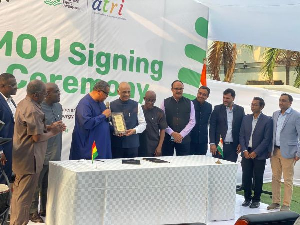
The Government of Ghana has signed a memorandum of understanding with India-based renewable energy firm ATRI Energy Transition Private Limited to support its flagship 24-Hour Economy programme through large-scale clean power generation.
The agreement was signed in Accra on March 5, 2026, by the 24-Hour Economy and Accelerated Export Development Secretariat and ATRI Energy Transition, marking the first of several planned joint development partnerships aimed at expanding Ghana’s renewable energy capacity.
Presidential Advisor on the 24-Hour Economy, Mr. Goosie Tanoh, said the partnership is expected to deliver up to 2,000 megawatts of renewable energy to Ghana’s national grid over the next five years to sustain round-the-clock economic activity.
The initiative will include the development of about 40,000 hectares of grass plantations, solar parks, and agro-ecological zones, alongside related value-chain projects supporting energy production and transport infrastructure.
Mr. Tanoh said the projects could generate around 160,000 direct and indirect jobs through a range of large-scale investments linked to the programme’s industrial and export-oriented growth strategy.
He added that the scheme also sets electricity cost limits to ensure affordable power for businesses operating within the 24-hour economy framework.
Under the pricing structure, power generated with battery storage will be capped at seven cents per kilowatt-hour, while projects without storage are expected to produce electricity at between four and five cents, significantly below Ghana’s current average of about 15 cents.
ATRI Energy Transition founder Sammidi Kishore said the company plans to establish a 20-tonne-per-day biofuel production facility and build a 100-megawatt solar installation as part of the partnership.
He added that the company is also considering mobility initiatives, including converting or deploying between 500 and 1,000 electric buses in Ghana within the next two years.
Kishore said the collaboration could also unlock opportunities to harness agricultural and hydrological resources along the Volta Basin to support industrial-scale biofuel production and strengthen Ghana’s renewable energy ecosystem.