

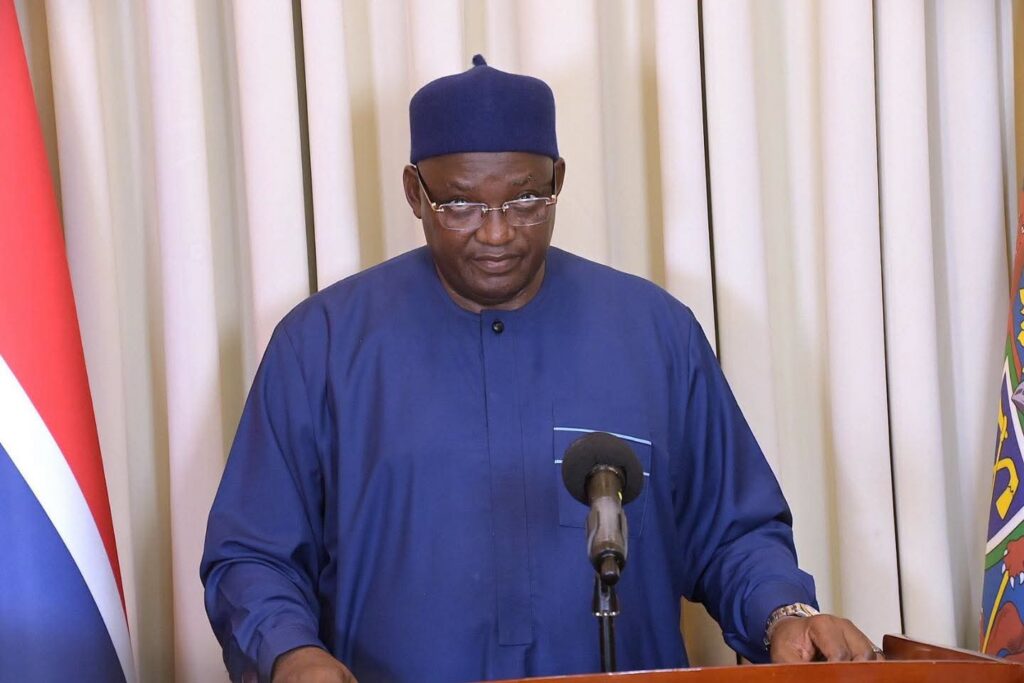
Gambian President Adama Barrow has pledged to improve electricity supply across the country by the end of October 2026, following growing public frustration over prolonged power outages affecting homes and businesses.
The president’s commitment comes after persistent electricity disruptions triggered public protests in the capital, Banjul, on Monday night. Demonstrators reportedly marched through parts of the city carrying candles and chanting for the restoration of electricity.
President Barrow visited the National Water and Electricity Company (NAWEC) on Tuesday before addressing the nation from State House later that evening.
He said the government was working to expand the country’s power generation capacity, including the installation of an additional 24 megawatts at the Brikama Power Station and the development of a 50-megawatt solar power plant in Soma.
“I must admit, however, the shortcomings in our planning, power generation, and maintenance systems to take corrective measures,” President Barrow said.
The president acknowledged the difficulties caused by the outages, noting that families were struggling with excessive heat, children were forced to study without electricity and households were losing food due to inadequate refrigeration.
“I am aware of your discomfort and frustrations wherever you may be,” he said.
President Barrow said the electricity challenges were partly linked to a broader shortage of power across the region, with countries connected to the West African Power Pool facing similar difficulties.
He pointed to unusually high electricity demand, breakdowns involving major generating units and seasonal factors affecting hydropower generation through the Organisation for the Development of the Gambia River (OMVG) as some of the factors behind the regional supply constraints.
At the same time, the president admitted that shortcomings within the country’s own power system had also contributed to the crisis.
According to President Barrow, installation of the additional 24-MW generation unit at the Brikama Power Station is nearing completion and is expected to be commissioned by the end of October.
He also disclosed that a contract had been secured for the construction of a 50-MW solar power plant at Soma, with the contractor already mobilising equipment and resources for the project.
The solar facility, he explained, would help satisfy electricity demand during the day, enabling conventional power generators to be preserved for periods of higher demand in the evening.
To strengthen oversight of the situation, Barrow announced the creation of a Presidential Task Force on Electricity Supply, chaired by Vice President Muhammed B.S. Jallow.
The task force will report directly to the president and issue public updates on developments in the electricity sector every two weeks.
President Barrow also highlighted his government’s progress in expanding access to electricity, saying national electricity coverage had increased from 36% of the population in 2017 to approximately 90% today.
He said the expansion had connected numerous communities that previously lacked electricity, but stressed that the government must now focus on ensuring adequate and dependable generation capacity as demand continues to rise.
“What we have achieved in increasing access to electricity is what we are determined to do for power generation,” President Barrow said.
The president further appealed to citizens to remain peaceful following the protests and cautioned against vandalising electricity infrastructure, including transformers and power lines.
“You have the right to express your views honestly, but let us not, in our frustration, tear down what we built with our own hands through public funds,” President Barrow said.
He warned that damage to power infrastructure could worsen electricity disruptions while forcing the government to redirect funds towards repairs and replacement.
Although President Barrow did not promise that the outages would end immediately, he provided a specific deadline by which he expects the situation to improve.
“I will not promise you what the Government cannot deliver, but we commit that the electricity supply situation in the country will improve by the end of October 2026,” he said.
He called on Gambians to exercise patience and restraint while engineers and government officials work to restore stability to the country’s electricity system.