

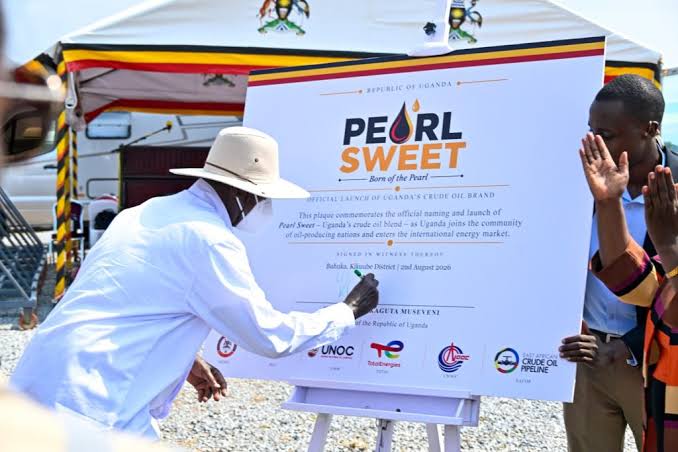
Uganda has officially named its crude oil export blend “Pearl Sweet”, giving the country’s developing petroleum industry a distinct commercial identity ahead of its entry into the international oil market.
President Yoweri Kaguta Museveni announced the name on Wednesday during a ceremony at the Kingfisher Development Area in western Uganda.
The designation is expected to establish Uganda’s crude as a recognisable grade in the global market, enabling refiners, traders and other industry participants to identify the oil by its origin and specific characteristics.
The term “Pearl” is derived from Uganda’s description as the “Pearl of Africa”, while “Sweet” reflects the crude’s comparatively low sulphur content, a quality that can make crude more appealing to refiners.
Officials classify the crude as medium light, with an API gravity of between 28 and 31 degrees. Generally, crude with a higher API gravity is lighter and can produce a greater share of lighter petroleum products. However, factors such as sulphur content and prevailing market conditions also determine the commercial value of crude.
At the naming ceremony, President Museveni said Uganda’s approach to developing its petroleum industry was intended to ensure that the country captures significant domestic economic benefits from its resources.
“What you sow is what you reap,” President Museveni said in reference to the government’s efforts to develop the industry locally.
He emphasised the importance of processing crude within Uganda, saying local refining would contribute to economic growth and environmental protection. He also reiterated the country’s policy against gas flaring.
“Oil is a finite resource, and its benefit must be for future generations,” President Museveni said.
According to the president, Uganda’s petroleum resources have the potential to substantially transform the economy if they are properly managed and connected to broader industrial development.
“The petroleum industry would push us very far,” President Museveni said, referring to a planned refinery that is expected to manufacture vehicle fuels, aviation fuel and other petroleum products.
“So, what is happening here is not a joke. It will have a lot of implications,” he added.
President Museveni said Uganda should view its oil wealth as more than an export opportunity, arguing that the resources could also provide a foundation for developing industries and increasing the country’s productive capacity.
Government data shows that approximately 6.5 billion barrels of oil resources have been confirmed in the Lake Albert region, with an estimated 1.65 billion barrels considered recoverable.
The president, however, noted that substantial exploration potential remains, as only about 40% of Lake Albert has so far been explored.
“The 6.5 billion barrels of oil that were confirmed only cover 40% of Lake Albert. We still have 60% to explore,” he said.
President Museveni also expressed appreciation to petroleum industry partners, including TotalEnergies and CNOOC, for their contribution to the development of Uganda’s oil sector.
He particularly commended CNOOC for the speed at which it has advanced its work and encouraged other partners to accelerate their activities.
“I want to thank CNOOC here because they have moved very fast. I want the others to also work very fast,” he said.
The president further reaffirmed that Uganda would not permit associated gas from the Kingfisher field to be flared. Instead, the gas will be used to generate electricity and produce liquefied petroleum gas (LPG) for cooking.
“Here, we said no to flaring gas. We shall be using the gas to generate electricity, up to 80 megawatts at Kingfisher alone,” President Museveni said.
“The other gas will be condensed and turned into liquefied petroleum gas for cooking,” he added.
Energy and Mineral Development Minister, Hon. Monica Musenero Masanza described the naming of Pearl Sweet as an important milestone as Uganda moves closer to starting commercial oil production.
“Uganda’s oil journey is anchored on efficiency, responsibility and ensuring that our resources create lasting value for Ugandans,” she said.
Petroleum Authority of Uganda (PAU) Chairperson, Lynda Biribonwa said the country should use its petroleum resources to build skills, businesses, infrastructure and technological capacity while promoting industrialisation and strengthening energy security.
Uganda National Oil Company (UNOC) Chief Executive, Proscovia Nabbanja said the name would help establish Uganda’s crude as a recognisable traded grade and assist the company in developing commercial relationships with refiners and traders.
Chinese ambassador to Uganda Wu Guangrong also reaffirmed China’s commitment to strengthening bilateral cooperation with Uganda in oil and gas, trade, infrastructure and investment.
He said such cooperation should go beyond the extraction of resources to include skills development, job creation, local content and industrial development.
Crude produced from the Tilenga and Kingfisher developments will be combined at the Kabaale Shared Facilities in Hoima before being transported through the East African Crude Oil Pipeline (EACOP).
The 1,443-kilometre heated pipeline will transport the crude to Tanzania’s Tanga port for export.
Uganda’s Lake Albert petroleum development is centred on the Tilenga and Kingfisher projects. Tilenga, operated by TotalEnergies EP Uganda, is expected to reach peak production of approximately 190,000 barrels of oil per day.