
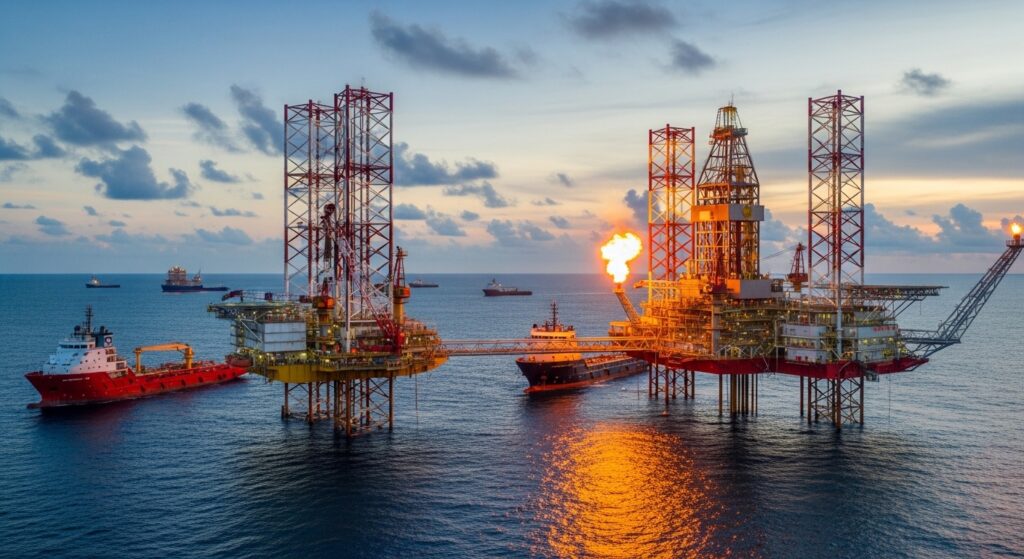
Ghana’s Parliament has approved extensions of major petroleum agreements covering the West Cape Three Points and Deepwater Tano blocks, in a move aimed at safeguarding upstream operations and sustaining production in ageing oil and gas fields.
The revised deals, endorsed after review by the Energy and Finance Committees, prolong the licences to Dec. 31, 2040, and are projected to unlock up to $2 billion in fresh capital expenditure for new wells and subsea infrastructure to counter declining output.
The agreements involve the government, the Ghana National Petroleum Corporation and its exploration arm, alongside Tullow Ghana Limited, Kosmos Energy Ghana HlC, Kosmos Energy Ghana Investments and PetroSA Ghana Limited.
Lawmakers also approved a master gas agreement among the state, GNPC and its subsidiary Explorco, and the contractor parties to strengthen gas supply and payment structures.
The proposals were first presented to Parliament on Dec. 19 last year and Feb. 13 this year, before being referred for scrutiny and subsequently adopted following a report by the Energy Committee chaired by Emmanuel Bedzrah.
According to the committee, retaining the current operators preserves institutional knowledge of the Jubilee and TEN fields and reduces transition risks that could arise from premature licence termination or a change of operator.
The extension grants GNPC an additional 10% participating interest from July 20, 2036, raising its total stakes to 22.5% in the West Cape Three Points block and 25% in Deepwater Tano.
Projected gains to the state from the extended field life are estimated at $374 million in additional revenue, including about $255 million in gas savings, driven by higher production volumes and prolonged output.
The report said contractors sought a corporate income tax offset mechanism to secure payment for gas sales, citing outstanding arrears of $165.15 million under the Jubilee Gas Sale Agreement as of November 2025.
Under the arrangement, the Finance Ministry will reimburse any tax offsets into the Petroleum Holding Fund within 60 days of each fiscal quarter, in line with the Petroleum Revenue Management Act, as Ghana seeks to stabilise revenues and extend the economic life of its offshore assets.