

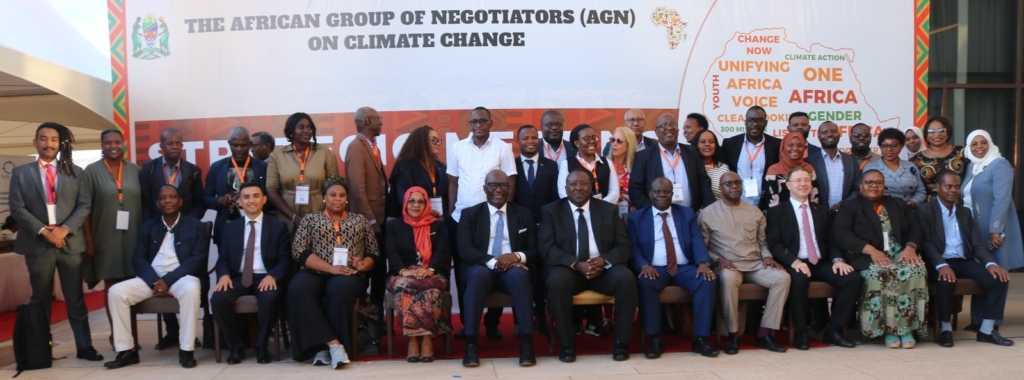
The Chair of the African Group of Negotiators on Climate Change (AGN), Dr. Richard Muyungi, has reaffirmed the continent’s call for a Just Transition that reflects Africa’s unique energy challenges, where over 600 million people still lack access to electricity and 900 million lack clean cooking solutions.
Speaking at the first AGN Strategic Meeting in Zanzibar under the chairmanship of the United Republic of Tanzania, Dr. Muyungi emphasized the importance of embedding the AU Declaration on Clean Cooking and the Dar-es-Salaam Declaration on Mission 300 Energy Summit—endorsed by the African Union—into the global Just Transition and mitigation work programmes leading to COP30 in Belém.
These initiatives, including the clean cooking agenda championed by President Samia Suluhu Hassan of Tanzania, aim to provide access to energy for at least 300 million Africans by 2030.
The AGN also reinforced the meaning of a “just transition” in the climate context: a shift to a low-carbon economy that supports equitable development, protects livelihoods, ensures decent work, and prevents communities from being left behind. The fourth session of the Conference of the Parties to the Paris Agreement (CMA) established a work programme to support nationally defined Just Transition pathways, emphasizing social protection and development priorities.
During the meeting, African negotiators committed to:
Finalizing the continent’s position for the next round of Nationally Determined Contributions (NDCs 3.0), making them ambitious, fair, and backed by sufficient support;
Securing clarity and operationalization of the New Collective Quantified Goal on climate finance, aligned with the “Baku to Belém Roadmap to $1.3 trillion by 2035”;
Advancing adaptation through clear targets under the Global Goal on Adaptation and strong progress on National Adaptation Plans;
Defending Africa’s equity-based position in global discussions on loss and damage, technology transfer, transparency, and Just Transition work programmes;
Prioritizing gender and youth inclusion as core to effective and inclusive climate action;
Leveraging Africa’s significant renewable resources such as solar, wind, and hydropower—for low-carbon development and global emissions reduction.
Dr. Muyungi emphasized AGN’s technical role in advising the African Ministerial Conference on the Environment (AMCEN) and the Committee of African Heads of State on Climate Change (CAHOSCC), ensuring consistent, coordinated African engagement at international climate negotiations.
Pan-African Climate Justice Alliance (PACJA) Executive Director, Dr. Mithika Mwenda, also addressed the meeting, calling for adaptation and resilience-building to remain central to Africa’s climate strategy, particularly in light of the continent’s exposure to climate risks despite its minimal contribution to global emissions. He stressed that adaptation finance must be scaled up, predictable, and accessible to support vulnerable communities.
The AGN concluded the meeting with a firm commitment to a science-based, justice-centered approach to negotiations at COP30 and beyond, anchored in the mandates of the African Union, AMCEN, and CAHOSCC.