

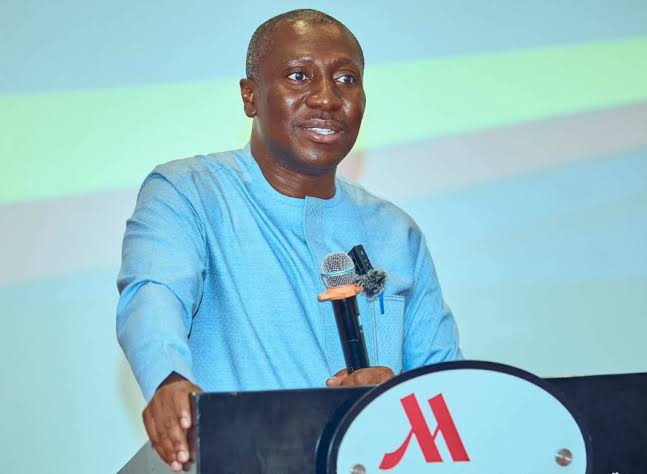
Former Electricity Company of Ghana (ECG) Board Chairman and Minority Leader in Parliament, Hon. Alexander Kwamena Afenyo Markin, has called for sweeping reforms at the state owned power distributor to improve its financial performance and operational efficiency, arguing that the utility must address existing inefficiencies before considering further tariff increases.
In a Facebook post on Sunday, Mr. Afenyo Markin outlined three key measures to strengthen ECG’s finances: strict enforcement of the revised Cash Waterfall Mechanism, renegotiation of legacy take or pay power purchase agreements, and automatic monthly deductions by the Ministry of Finance to settle outstanding debts owed to ECG by public institutions.
He said ECG’s challenges were rooted in longstanding structural inefficiencies that required a broader national conversation on reform rather than partisan accusations.
According to him, electricity consumers have endured cumulative tariff increases of more than 28 per cent over the past 19 months, yet the fundamental problems affecting the utility remain unresolved.
Citing ECG’s financial performance, Mr. Afenyo Markin said the company’s loss after tax declined from GH¢8.25 billion in 2024 to GH¢2.52 billion in 2025, representing a reduction of nearly 70 per cent. Revenue also increased from GH¢19.6 billion to GH¢22.1 billion over the same period.
He added that new electricity connections rose by 31.3 per cent to 222,979, while prepaid customers represented 53.5 per cent of ECG’s total customer base.
Although he acknowledged these improvements, he cautioned that the gains were not yet firmly established and urged the utility to address revenue losses before pursuing additional tariff increases or introducing new levies.
“Reform has achieved what tariff increases alone could not,” he said.
Mr. Afenyo Markin also advocated stronger expenditure controls and the continuation of procurement reforms introduced during his tenure as board chairman.
He recalled that, before the reforms, vendors could submit bills of lading for goods delivered to the port without sufficient verification of the consignments.
According to him, the practice exposed ECG to financial liabilities before the company had taken possession of the goods, leaving it vulnerable to accumulating port charges, delays and potential losses arising from damaged or missing items and disputes.
He said he had led the board to introduce a system linking contractual completion and payment to the verified delivery of goods at ECG’s own facilities.
“I led the Board to tie contractual completion and payment to verified delivery at ECG’s own facilities,” he said.
“That reform must be sustained,” he added.
The former board chairman further called for the full implementation of ECG’s Loss Reduction Programme, including boundary metering, smart prepaid meters and systematic measures to detect and prevent electricity theft.
He argued that these interventions, combined with strict enforcement of the Cash Waterfall Mechanism, would help the utility recover lost revenue, improve financial sustainability and reduce pressure to transfer operational costs to consumers through higher electricity tariffs.
Mr. Afenyo Markin also commended ECG Managing Director Kwame Kpekpena and his management team for recently organising a luncheon for former managing directors and board chairpersons of the company.
He said the gathering provided an opportunity for former leaders to exchange ideas and contribute to efforts aimed at improving ECG’s operational and financial performance.