

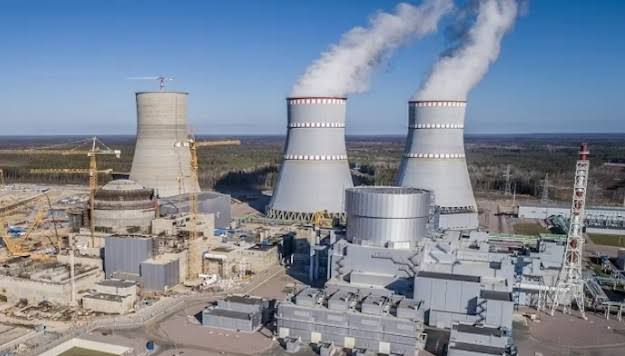
Russia is planning to commission about 30 gigawatts of new nuclear capacity as President Vladimir Putin seeks to expand atomic power beyond the country’s traditional nuclear-generation centres and use it to drive industrial development.*
Under the programme, new nuclear power plants including small nuclear facilities will be developed across the Urals, Siberia and the Far East, according to a Russian government statement issued on August 20, 2026.
Putin said the expansion is intended not only to replace generating units approaching the end of their operating lives, but also to significantly increase Russia’s overall nuclear generation capacity.
He said the wider geographic deployment of nuclear plants would provide the energy foundation for regional development and support the creation of new energy-intensive industries.
These include projects focused on the deep processing of natural resources in the Arctic, Siberia and the Far East.
38 new nuclear units planned
The scale of the planned expansion is underscored by figures from Russia’s state nuclear corporation, Rosatom.
Rosatom says 38 new nuclear power units are planned, while 18 units including small and floating nuclear power plants—are already under construction at nine sites.
At the same time, the company plans to retire 13 existing nuclear units representing more than 10 gigawatts of capacity over the next decade.
That would amount to roughly one-third of Russia’s currently operating nuclear units, making the planned construction important not only for expansion but also for replacing ageing generating capacity.
Nuclear power gains ground in Russia’s energy mix
Nuclear power currently accounts for about 19 percent of Russia’s electricity generation, according to the data provided, placing it behind natural gas at 42 percent and alongside coal at 19 percent. Hydropower accounts for about 17 percent.
The government wants nuclear generation to provide 25 percent of Russia’s electricity by 2045.
The expansion is also consistent with Russia’s longer-term energy strategy. The country’s Energy Strategy to 2050 envisages total installed power capacity rising from 253 gigawatts in 2023 to at least 275 gigawatts by 2030, 287 gigawatts by 2036 and 331 gigawatts by 2050.
Renewable capacity is also expected to increase by more than 40 percent by 2050.
Nuclear at the centre of Russia’s future power build-out
Nuclear power is already a major component of Russia’s new generation pipeline, accounting for about half of power-project capacity under construction and nearly 70 percent of capacity under development, according to the data provided.
The planned build-out therefore goes beyond replacing ageing reactors.
For Moscow, nuclear expansion is being positioned as a long-term tool for energy security, regional development and industrialisation, particularly in resource-rich parts of the country where new, energy-intensive production is expected to emerge.