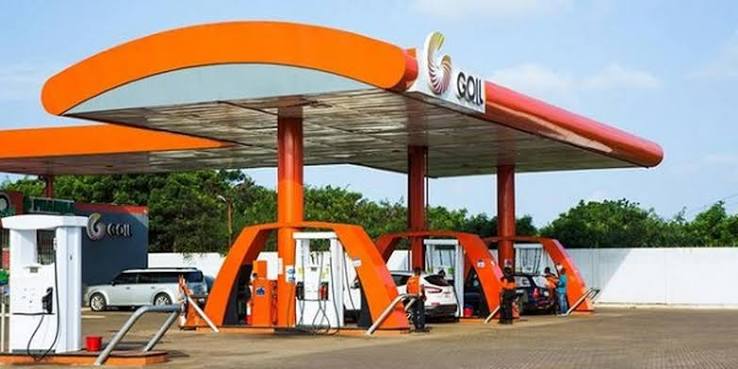

GOIL has questioned the justification for the Ghana Private Road Transport Union’s (GPRTU) proposed 30% increase in transport fares, arguing that changes in fuel prices should not be the only basis for adjusting fares.
GOIL Chief Executive Officer, Mr. Edward Bawa said factors such as the cedi to dollar exchange rate, spare parts, insurance and other operating costs should also be taken into account before any decision is made on transport fares.
His comments come as international crude oil prices approach $100 per barrel, raising concerns about possible increases in domestic fuel prices and the resulting effect on transportation costs.
Mr. Bawa said GOIL was still assessing developments in the global oil market and considering different measures to reduce the impact on consumers.
“We will get there. We’re still looking, or we’re still studying the various scenarios, still looking at what we should do, but what I can assure Ghanaians is that we will always want to be on their side,” he said.
He explained that although GOIL must ensure that its costs are covered, the company would also consider the effect of any pump price increases on consumers.
“Prices going up does not necessarily mean that at the pumps it will go up. It again depends on what strategy you are using. So GOIL will definitely find a way of trying to tame the market,” he said.
Mr. Bawa said GPRTU’s assessment of transport fares should reflect the broader cost environment rather than focus solely on petroleum prices.
“I understand GPRTU as a union body that the parameters considered in lorry fares are not only fuel. There is also the issue of the exchange rate because of spare parts. There is an issue of insurance and all other things that come into it,” he said.
He added that the relative stability of the cedi should also be factored into any review of transport fares.
“You realise that over the period, whilst prices of crude oil are going up, you have a fairly good situation within the country; you have a situation where the cedi and everything is still very fairly stable,” he said.
Mr. Bawa therefore questioned the practice of increasing commercial transport fares whenever fuel prices rise.
“And so, it is unfair that anytime there’s in fuel prices, you have lorry commercial drivers at to increase,” he said.
He acknowledged that the Ministry of Transport collaborates with GPRTU in determining the thresholds for transport fare adjustments.
According to him, fare increases are expected to be considered when the combination of relevant cost factors reaches the established threshold.
Mr. Bawa urged GPRTU to assess the wider economic conditions before proceeding with its proposed adjustment.
“I think that is the reason why, and I want to believe that GPRTU also knows these factors, and maybe they could add that to it,” he said.
He also said GOIL has a role to play in helping transport operators manage their costs and keeping fares within reasonable levels.
“But of course, as for GOIL, as a company, we must also be seen to be making the work of GPRTU and all other driver unions a bit easier for them to be able to insist on their drivers not to increase, having factored in when we are taking our price,” he said.
Mr. Bawa acknowledged that developments in the international oil market continue to create uncertainty and pressure for oil marketing companies.
“Anytime I see this, consistently you see that I am on my phone and the TV is on either CNN or other networks, just to see what is happening,” he said.
He said geopolitical developments remain a concern for oil marketing companies because of their potential impact on global petroleum prices.
“As a provider of petroleum products to customers, you want to ensure that your customers are not overly burdened because of the pricing,” he said.