
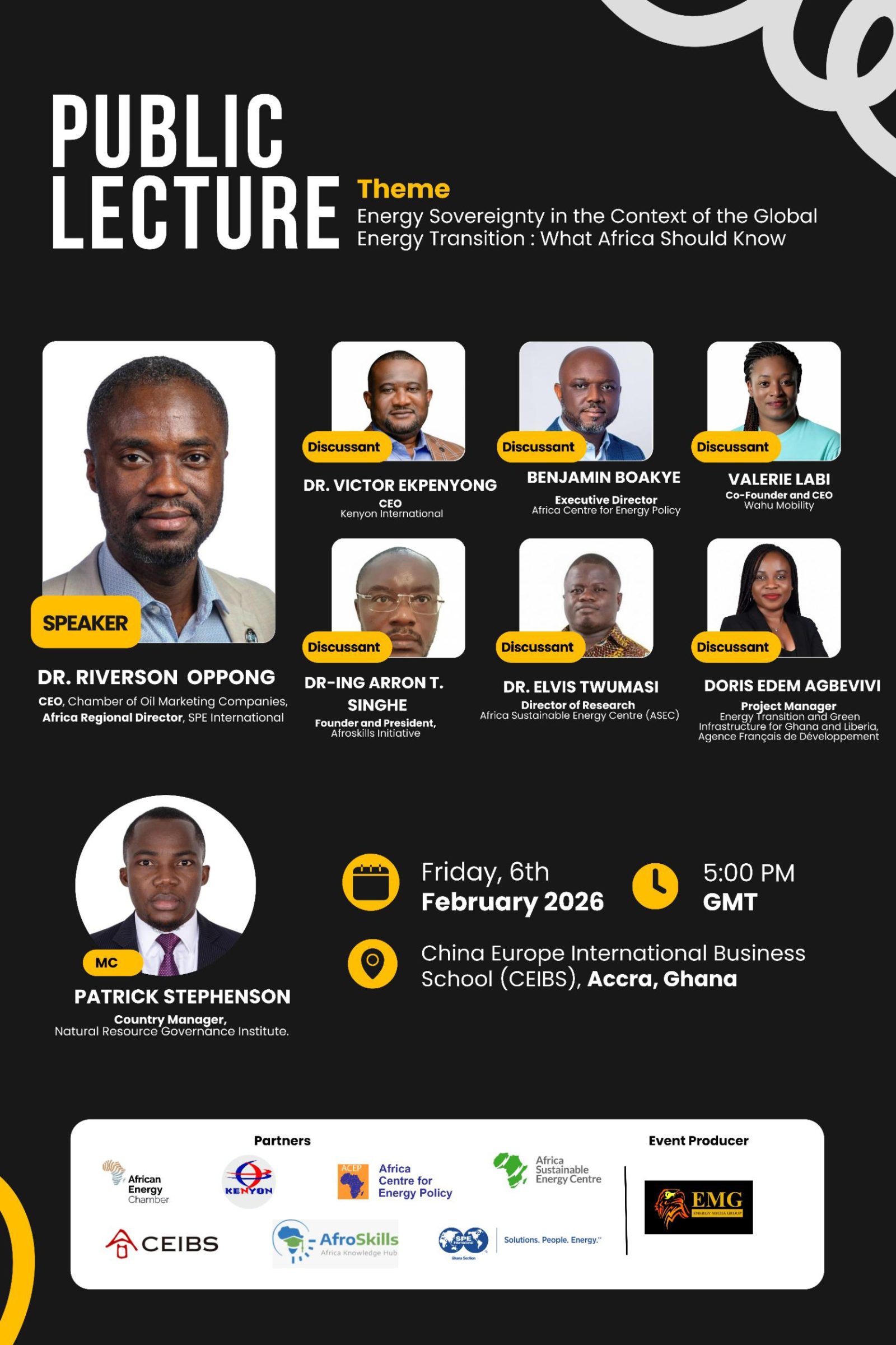

While much of the world accelerates its shift toward green energy, the African continent faces a unique paradox. It is endowed with abundant solar, wind and geothermal resources, as well as an estimated 600 trillion cubic feet of natural gas; yet nearly 600 million people still live without access to reliable electricity.
It is against this backdrop that, on Friday, 6th February 2026, the China Europe International Business School (CEIBS) Auditorium in Accra will host a landmark public lecture on the theme “Africa’s Energy Sovereignty in the Global Transition.” The event, scheduled from 5:00 pm to 8:00 pm, aims to spark informed dialogue on how Africa can assert strategic control over its energy future while advancing economic growth and meeting global climate commitments.
The public lecture will feature a lead presentation by Dr. Riverson Oppong, Chief Executive Officer of the Chamber of Oil Marketing Companies (COMAC), followed by plenary discussions covering key areas of Africa’s energy sector.
Africa is characterised by strong regional imbalances. South Africa and North Africa account for less than 20% of the population but more than 45% of energy investment and over 65% of installed electrical capacity. By contrast, Sub-Saharan Africa, home to most of the region’s population, receives less energy investment and has limited access to reliable electricity. New connection rates have steadily increased since 2000 but remain well below the universal access target set for 2030, with 600 million people still lacking electricity access and more than 1 billion people without clean cooking. (IEA Report).
Africa’s overall generation is estimated to rise from nearly 980 TWh today to nearly 1,400 TWh by 2030, alongside a fundamental shift in the energy mix that would see the share of renewables rise from 27 percent to 43 percent. Achieving this transformation requires not only infrastructure investment but also coherent policies, regional cooperation, and access to appropriate technology and financing.
Public and development finance (DFI) funding for energy projects in Africa has fallen by approximately one-third in the last ten years, reaching USD 20 billion in 2024, highlighting persistent constraints related to finance, technology access, and governance. The lecture, therefore, seeks to challenge prevailing narratives and explore pathways for Africa to build resilient energy systems, move beyond dependency, and secure a just and pragmatic energy transition shaped by its own priorities.
Policymakers, industry leaders, investors, academics, development partners, students, and energy professionals are therefore invited to participate in this critical conversation. The public lecture provides a timely platform for stakeholders to engage, exchange perspectives, and contribute to shaping Africa-led solutions for energy security, economic transformation, and climate resilience.
This public lecture is being hosted in partnership with the China Europe International Business School (CEIBS) and organized in collaboration with the Africa Energy Chamber, the World Energy Council, the Africa Center for Energy Policy (ACEP), Kenyon International, and the Africa Sustainable Energy Center. The event is produced by Energy Media Group Ghana.
Source: Energy Ghana