

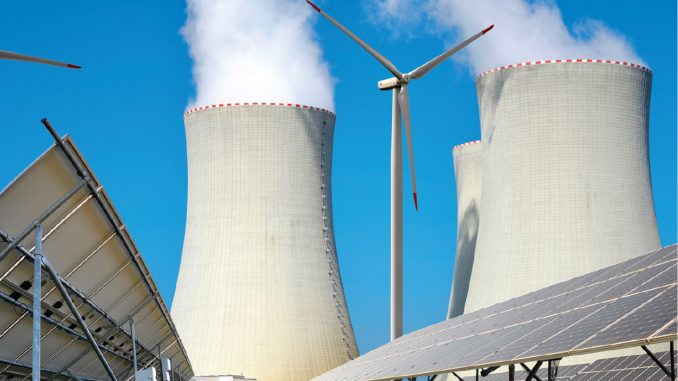
The U.S. power sector is entering a period of rapid transformation, with electricity demand climbing from data centers, artificial intelligence, electric vehicles, businesses, and households. Utilities are scrambling to expand capacity, while federal policy changes under President Donald Trump have reshaped the pace of renewable energy growth.
The U.S. Energy Information Administration (EIA) regularly issues decade-long projections on power capacity, outlining how different sources are expected to evolve. These forecasts, while subject to change, provide a baseline for understanding the nation’s energy trajectory over the next 10 years.
Natural gas is projected to remain the dominant energy source, despite policy shifts. EIA data shows gas-fired power capacity will grow about 3% to reach 523.3 gigawatts (GW) by 2035. However, its overall share of the power mix is set to decline from 42% today to 38% by 2028, then hold steady.
Coal, meanwhile, faces a sharper decline as aging plants shut down. Its contribution to the energy mix is expected to fall from 14% now to 10% by 2035, with total capacity shrinking from 167 GW to about 133 GW.
Nuclear power and hydroelectric energy are projected to remain largely stable but with reduced shares. Nuclear will hover around 98.4 GW, while hydropower capacity is expected to inch upward from 84.2 GW, even as their percentage shares slip slightly.
The clearest growth story lies in renewables. Solar, wind, and battery storage are expected to expand significantly, leveraging their faster adoption rates and improving technologies to capture a larger slice of the U.S. energy mix.
In 2025, both solar and wind are projected to account for about 13% each of generation capacity. By 2035, those figures are expected to rise, positioning renewables as the strongest growth segment in the sector.
Despite the Trump administration’s rollback of green energy incentives, the momentum of clean energy deployment remains robust, driven by falling costs and demand for low-carbon solutions.
The EIA stresses that actual capacity growth could diverge from projections, especially under political and economic pressures. Nonetheless, the current outlook suggests a future where natural gas retains dominance, but solar and wind steadily gain ground.
This evolving mix underscores the challenges and opportunities in balancing U.S. energy security, environmental goals, and rising electricity demand over the next decade.