

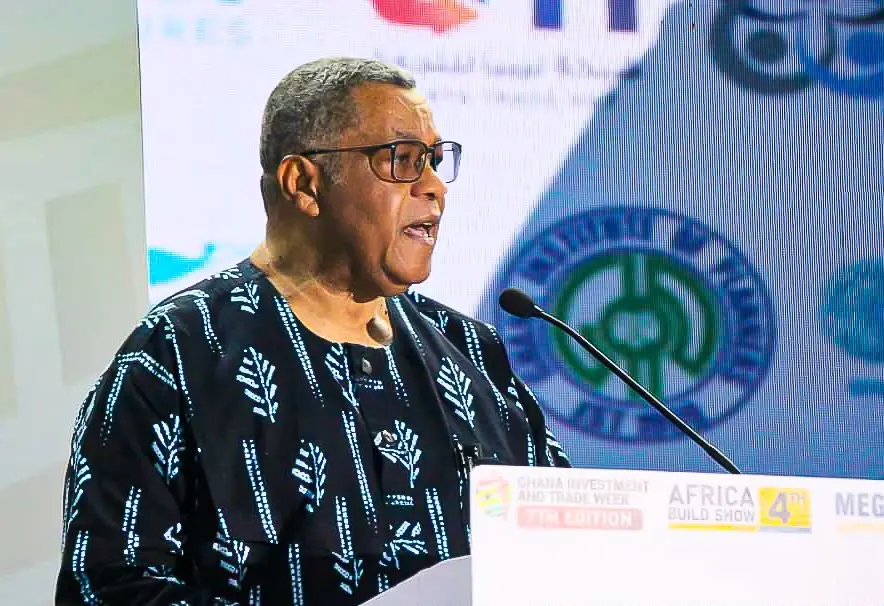
Presidential Advisor to the 24-Hour Economy and Accelerated Export Development Secretariat, Goosie Tanoh, has urged Ghana to accelerate investment in renewable energy, warning that failure to do so could leave the country relying on imported electricity in the future.
Speaking at the Ghana Investment and Trade Week, organised by the Ghana Chamber of Construction Industry, Mr. Tanoh said expanding renewable energy generation is critical to supporting the government’s industrialisation agenda and sustaining the proposed 24-hour economy.
He noted that while many countries are investing in cleaner and lower-cost electricity generation technologies, Ghana risks falling behind unless it prioritises similar investments.
Mr. Tanoh revealed that the 24-Hour Economy and Accelerated Export Development Secretariat, in collaboration with private investors, is implementing a number of renewable energy projects within its industrial parks to provide reliable electricity for round-the-clock industrial production.
According to him, renewable energy offers a more sustainable and cost-effective solution than fossil fuels, whose supplies are limited and require continuous expenditure in foreign currency.
He explained that although renewable energy systems require an initial capital investment, sources such as solar energy provide long-term savings because the energy itself is freely available, adding that the cost of solar technology has declined significantly over the years.
Mr. Tanoh also pointed to recent geopolitical tensions in the Middle East, including concerns over shipping through the Strait of Hormuz during the Iran-Israel conflict and U.S. military involvement, as evidence of the vulnerability of countries that depend heavily on fossil fuels.
Highlighting international examples, he said China has expanded its solar power capacity more rapidly than any other country, helping to strengthen its industrial base while reducing dependence on conventional energy sources.
He further referenced the United States’ Inflation Reduction Act of 2022, which committed substantial funding to clean energy projects, noting that Texas has become the leading U.S. state in new solar power installations due to the declining cost of solar electricity.
Turning to Africa, Mr. Tanoh cited Morocco’s Noor Ouarzazate Solar Complex, with an installed capacity of about 580 megawatts, as a model of how large-scale renewable energy investments can drive industrial development.
He reaffirmed the Secretariat’s commitment to expanding solar power projects across its industrial parks to ensure a reliable electricity supply for continuous manufacturing and support Ghana’s long-term industrialisation objectives.