
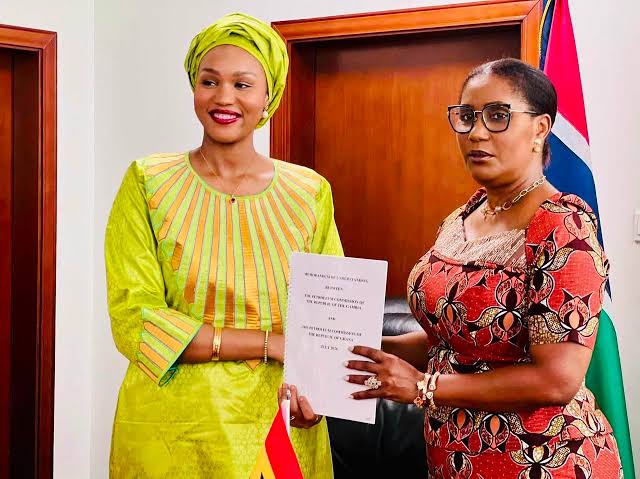
The Petroleum Commission of The Gambia and the Petroleum Commission of Ghana have formalised a partnership aimed at strengthening cooperation in the regulation and management of the upstream petroleum industry by signing a Memorandum of Understanding (MoU).
The agreement was signed in Banjul on July 10 by Director General of the Petroleum Commission of The Gambia, Engr. Cany Jobe, and Acting Chief Executive Officer of the Petroleum Commission of Ghana, Ms. Emeafa Hardcastle, during a three-day working visit by a Ghanaian delegation.
The MoU provides a framework for collaboration in key areas, including upstream petroleum regulation, local content development, petroleum data management, regulatory and legal systems, as well as compliance monitoring and enforcement.
It also seeks to strengthen institutional capacity through staff exchanges, technical training, study tours, internships, secondments, technical assistance and the implementation of joint programmes.
As part of the visit, the Ghanaian delegation paid courtesy calls on The Gambia’s Minister for Petroleum, Energy and Mines, Mr. Nani Juwara, and the Gambia National Petroleum Corporation (GNPC).
Mr. Juwara welcomed the delegation, conveyed his regards to Ghana’s Minister for Energy and Green Transition, Hon. Dr. John Abdulai Jinapor, and reaffirmed The Gambia’s commitment to deepening cooperation between the petroleum institutions of both countries.
Officials from the two commissions also held technical discussions on a wide range of issues, including regulatory governance, institutional development, upstream licensing and licence administration, local content implementation, public procurement, institutional financing, stakeholder engagement, human resource development and collaboration with Parliament and other oversight bodies.
Speaking at the signing ceremony, Engr. Cany Jobe described the agreement as a practical partnership built on shared learning and institutional development, stressing that strong regulatory institutions are essential for ensuring petroleum resources generate lasting national benefits.
She noted that while oil discoveries depend on geology, scientific expertise and investment, effective institutions ultimately determine whether those resources contribute to sustainable national development. She added that Ghana’s petroleum sector offers valuable lessons for emerging producers such as The Gambia.
Highlighting Ghana’s experience, she noted that the country has been producing oil commercially since 2010 from the Jubilee, TEN and Sankofa-Gye Nyame fields.
For her part, Ms. Emeafa Hardcastle described the signing of the MoU as a significant milestone that reflects the shared commitment of both institutions to closer collaboration.
She observed that African petroleum-producing and frontier countries are facing common challenges, including increased competition for investment and the ongoing global energy transition, making cooperation among regulators more important than ever.
According to her, the partnership will enable both institutions to share expertise, strengthen technical capabilities and pursue common development objectives. She emphasised that the success of the agreement would depend on effective implementation, adding that the next priority is to translate its commitments into measurable outcomes.
Permanent Secretary at The Gambia’s Ministry of Petroleum, Energy and Mines, Mr. Abdoulie Jallow, who represented the minister, reaffirmed the ministry’s support for the partnership, describing the agreement as an example of Pan-African cooperation and a demonstration of how African countries can accelerate development by learning from one another.
Under the MoU, the two petroleum commissions will establish a Joint Steering and Oversight Committee to oversee implementation, prepare annual work plans and coordinate technical cooperation through dedicated sub-committees.
The Petroleum Commission of The Gambia also expressed appreciation to the Petroleum Commission of Ghana for its continued partnership and acknowledged the support of the Ministry of Petroleum, Energy and Mines, its Board, management, staff and other stakeholders who contributed to the success of the visit.