

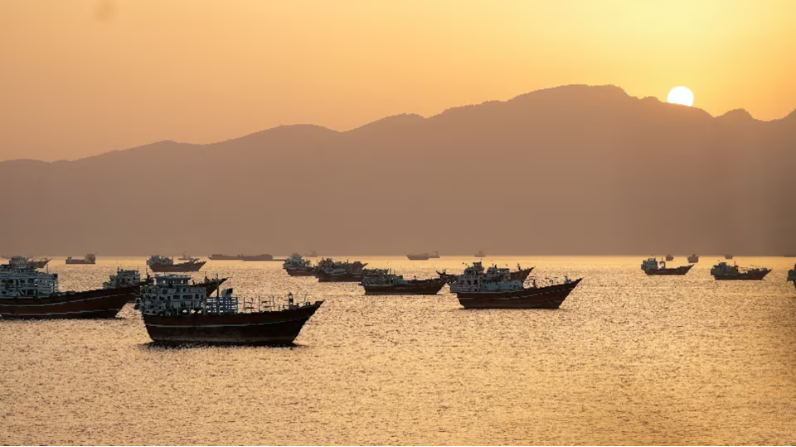
Three supertankers carrying roughly 6 million barrels of Middle Eastern crude were crossing out of the Strait of Hormuz on Wednesday after remaining in the Gulf for more than two months, highlighting limited signs of resumed oil shipments despite continued security threats linked to the U.S.-Israeli conflict with Iran.
The vessels, transporting crude from Kuwait, Iraq and Qatar to major Asian markets including South Korea and China, are among a small number of oil tankers navigating the route after Iran directed ships to follow designated transit corridors through the strategically vital waterway.
Shipping through the strait, which normally handles about one-fifth of global oil and energy flows, has sharply declined since the conflict began on February 28, with daily vessel movements falling from an average of 125–140 passages to around 10 in recent days.
Data from LSEG and Kpler showed South Korean-flagged tanker Universal Winner was carrying 2 million barrels of Kuwaiti crude to Ulsan, while Chinese-linked tankers Yuan Gui Yang and Ocean Lily were transporting Iraqi and Qatari crude bound for ports in Guangdong and Fujian provinces.
The reduced traffic has left around 20,000 seafarers stranded aboard hundreds of vessels inside the Gulf, while congestion risks are expected to intensify if navigation conditions improve and delayed ships attempt to depart simultaneously.
Maritime security concerns remain elevated, with the U.S.-led Joint Maritime Information Center reporting recent aggressive interactions involving Iranian units and warning that the operational environment continues to pose high risks for commercial shipping.
Industry groups issued fresh guidance on Wednesday, citing threats including potential attacks, drones, mines, unpredictable vessel movements and reduced military oversight in the area.
Separately, Cypriot-flagged tanker Grand Lady was reported entering the Strait of Hormuz with its transponder switched off before anchoring near Dubai, adding to concerns over transparency and safety in regional shipping activity.
The cautious movement of crude carriers underscores the fragility of global energy supply chains as geopolitical tensions continue to disrupt one of the world’s most critical oil transit routes.
Market participants are closely monitoring whether tanker movements increase in coming weeks, a key indicator of confidence in maritime security and the stability of international oil flows.