

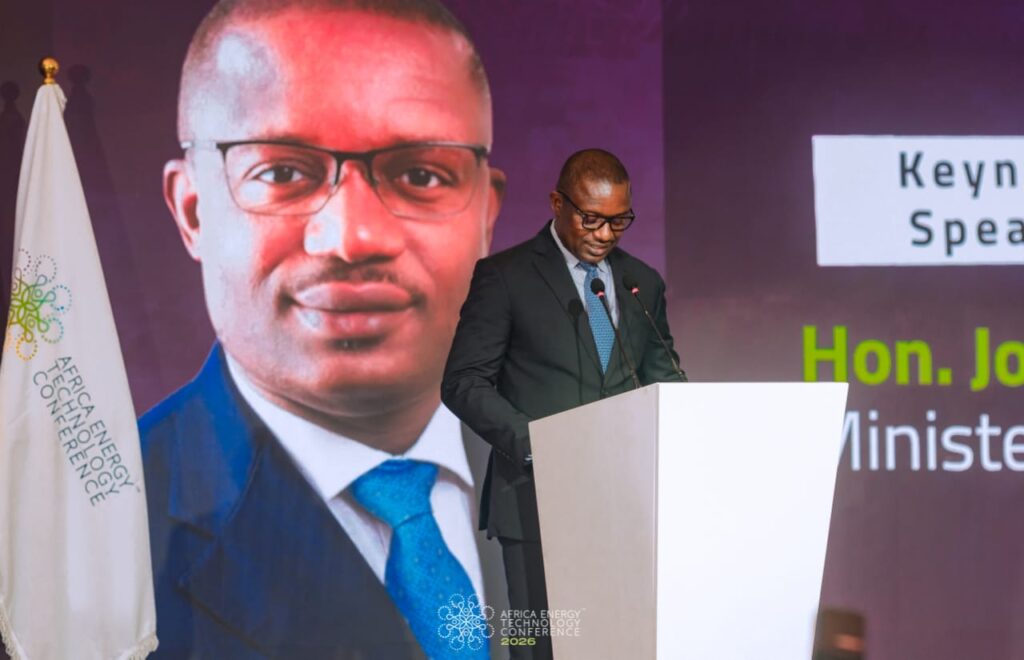
The Minister for Energy and Green Transition, Dr. John Abdulai Jinapor has called on African countries to deepen regional collaboration and pursue energy self-sufficiency following the global disruptions caused by the escalating conflict between the United States and Iran.
Speaking at the 3rd edition of the Africa Energy Technology Conference under the theme, “From Borders to Bridges: Driving Intra-African Trade and Development Through Energy and Technology Services,” the Minister said the closure of the Strait of Hormuz due to the conflict has exposed Africa’s vulnerability to external shocks, with some countries recording fuel price increases of more than 64 percent and others struggling with fuel availability.
According to him, the crisis serves as a wake-up call for Africa to build resilient and self-reliant energy systems through continental cooperation, strategic investments and industrialisation.
The Minister stressed that Africa must no longer remain merely a supplier of raw materials while other regions capture the technological and industrial value chains. He urged African leaders to focus on beneficiation, manufacturing, innovation and value addition to drive sustainable growth.
He noted that despite Africa’s vast natural resources, over 600 million Africans still lack access to electricity, while more than one billion people do not have access to clean cooking solutions, describing the situation as a major obstacle to economic transformation.
Highlighting Ghana’s energy situation, the Minister revealed that the country currently has about 5,000 megawatts of installed generation capacity against a peak demand of approximately 4,500 megawatts, leaving little reserve margin.
He disclosed that Ghana recently suffered a major fire outbreak at its largest hydroelectric dam, resulting in the sudden loss of about 1,000 megawatts of power generation capacity. However, local Ghanaian engineers restored the system within five days without relying on foreign expertise.
To strengthen Ghana’s energy security, he announced that the government is deploying more than 1,000 megawatts of emergency power while expanding electricity exports to neighbouring countries through the West African Power Pool.
The Minister said Ghana also imports natural gas from Nigeria to generate electricity for domestic use and regional export, describing it as a practical example of turning borders into bridges.
On renewable energy, the Minister said Ghana plans to increase renewable installed capacity from 280 megawatts to 600 megawatts through a competitive procurement process. He revealed that more than 50 companies have already expressed interest in the government’s newly launched solar bidding programme aimed at deploying between 200 and 400 megawatts of battery-supported solar power.
The government, he added, has also deployed 30,000 solar streetlights nationwide and plans to increase the number to 100,000 to reduce pressure on the national grid and improve efficiency.
The Minister further disclosed that Ghana is diversifying its energy mix by pursuing nuclear power partnerships with countries including the United States, Russia, France and China to secure affordable baseload electricity needed for industrialisation.
He said Ghana is transitioning from dependence on liquid fuels to a “gas-to-power” era by increasing domestic gas utilisation and constructing a second gas processing plant to support power generation.
The Minister also announced the establishment of a Renewable Energy Investment Fund financed through a small levy on petroleum products to mobilise domestic capital for renewable energy development.
He assured investors that Ghana remains open for business, citing the country’s political stability, improving regulatory framework and strategic position within Africa’s growing market. Calling on African leaders to move beyond fragmented markets, the Minister urged stronger regional integration, harmonised regulations and continental industrial cooperation to unlock Africa’s energy potential.
“Africa can either remain a producer of raw materials and consumer of imported value, or we become builders of industry, exporters of power, innovators of technology and architects of our own destiny,” he said.