
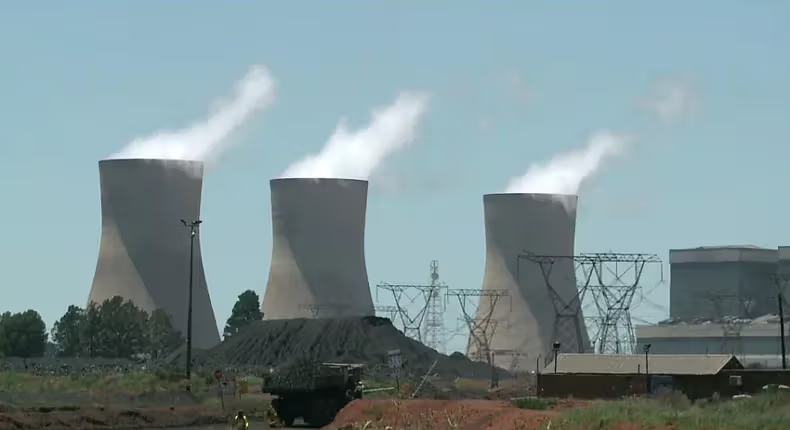

South Africa has announced bold plans to revive its modular nuclear reactor programme and expand its natural gas generation capacity, marking a major policy shift in the country’s long-term energy strategy. The new direction was outlined in a revised Integrated Resource Plan (IRP) unveiled by Electricity and Energy Minister, Kgosientsho Ramokgopa during a press briefing on Sunday, October 19, 2025, following cabinet approval last week.
According to the updated IRP, the government aims to invest 2.23 trillion rand ($128 billion) in energy infrastructure by 2042, positioning nuclear and gas to contribute 16 percent of total generation capacity over the next 14 years, compared to just 3 percent currently. Minister Ramokgopa described the initiative as “the single biggest investment programme of the post-apartheid era,” designed to ensure long-term energy security and economic stability.
The plan also envisions a sharp decline in the country’s coal dependence, reducing it from 58 percent to 27 percent by 2039, as South Africa transitions toward cleaner and more diversified energy sources. Ramokgopa emphasized that the IRP aligns with the nation’s broader goal of achieving net-zero electricity generation by 2050.
He further noted that the renewed nuclear focus reflects a global trend, with at least 14 major international financial institutions committing to support nuclear energy development worldwide. The minister assured that South Africa would not be limited to a small pool of financiers for its nuclear projects.
The revival of the pebble-bed modular reactor project, initially launched by Eskom Holdings SOC Ltd. in 1999, represents a return to a concept once abandoned in 2010 after $980 million in development costs. Officials now view it as a cornerstone of the nation’s energy resilience and innovation drive.
However, the move has already drawn skepticism from environmental and civil-rights organizations, including The Green Connection, whose strategic lead, Liziwe McDaid, warned that the nuclear and gas initiatives may face legal and public opposition, much like previous fossil-fuel projects.
As South Africa’s most industrialized economy continues to recover from years of rolling blackouts, the new IRP marks a decisive step toward balancing energy reliability, environmental responsibility, and economic growth in a rapidly changing global energy landscape.