

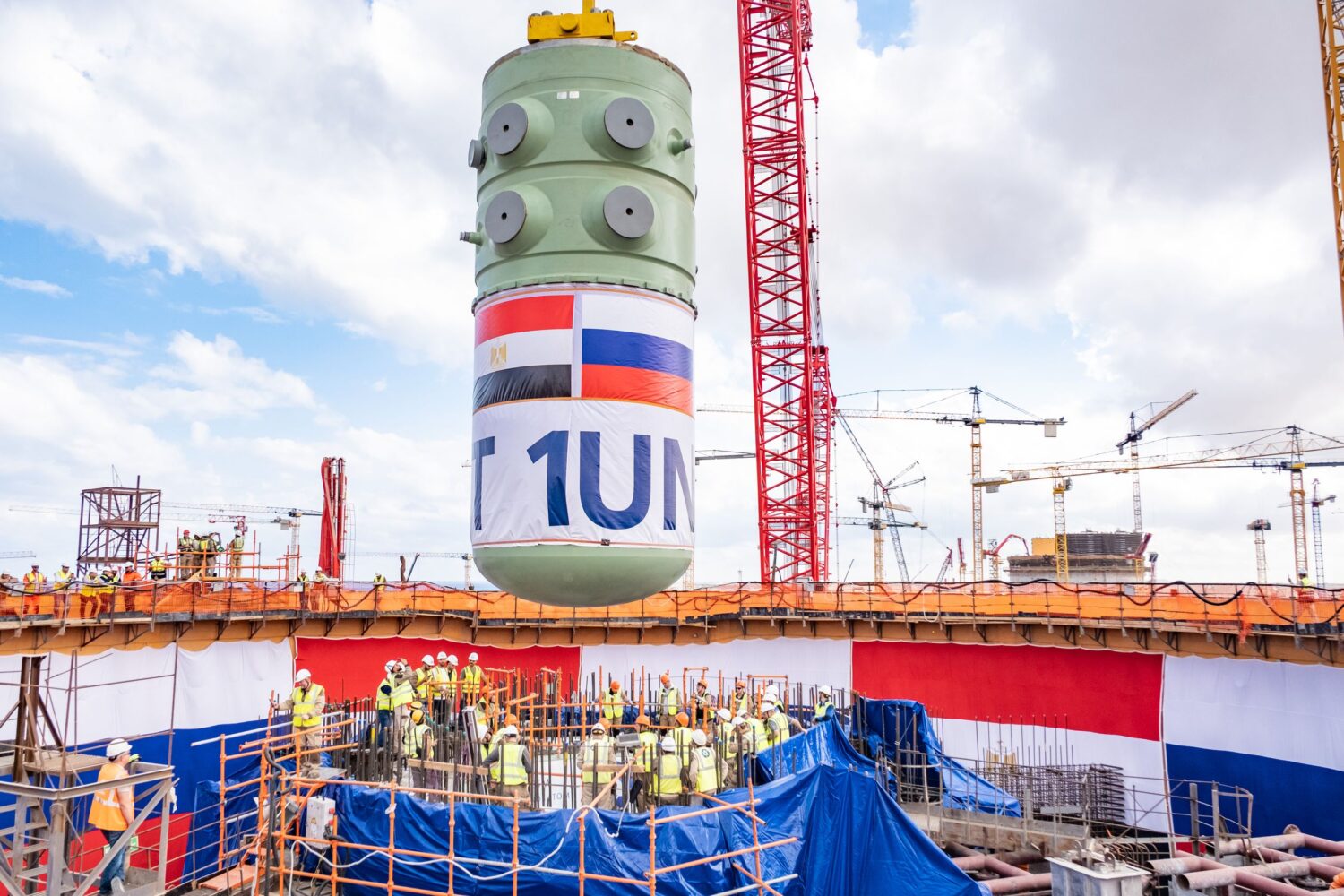
Russia’s Rosatom has installed the reactor pressure vessel at Unit 2 of Egypt’s El-Dabaa Nuclear Power Plant, marking another major milestone in the construction of the country’s first nuclear power station.
The installation was carried out during a ceremony attended by Rosatom Director General Alexey Likhachev, Egyptian Prime Minister Mostafa Madbouly, Minister of Electricity and Renewable Energy Mahmoud Esmat, and Director General of the International Atomic Energy Agency (IAEA), Rafael Grossi.
Situated on Egypt’s Mediterranean coastline in Matrouh Governorate, the El-Dabaa Nuclear Power Plant will consist of four generating units, each with an installed capacity of 1,200 megawatts (MW) and powered by Russian-designed Generation III+ VVER-1200 reactors.
Prime Minister Madbouly described the project as one of Egypt’s most significant national infrastructure investments, saying it would play a key role in achieving the country’s long-term energy objectives under Egypt Vision 2030.
The reactor pressure vessel is one of the most critical components of a nuclear reactor, enclosing the reactor core where controlled nuclear fission takes place.
Its successful installation at Unit 2 paves the way for the next stage of construction, including the welding of the main coolant pipeline.
Mr. Likhachev noted that construction is progressing steadily, highlighting that the same component was installed at Unit 1 just seven months earlier.
He said the latest achievement allows work to advance to another major phase in the plant’s development.
According to Rosatom, the reactor pressure vessel weighs more than 340 tonnes and was installed using a 1,350-tonne crawler crane, with positioning accuracy measured to within one-tenth of a millimetre.
The milestone moves Unit 2 closer to its physical start-up phase, during which nuclear fuel will be loaded into the reactor for the first time.
Under the bilateral agreement, Russia will construct the power plant, supply nuclear fuel throughout its operational lifespan, train Egyptian personnel, provide technical support during the first 10 years of operation and assist in developing facilities for the storage of spent nuclear fuel.
The El-Dabaa project comes amid growing interest in nuclear energy across Africa. Countries such as Ghana are pursuing civilian nuclear power programmes as part of their long-term energy strategies, with lessons from Egypt’s experience expected to support future nuclear energy development across the continent.