

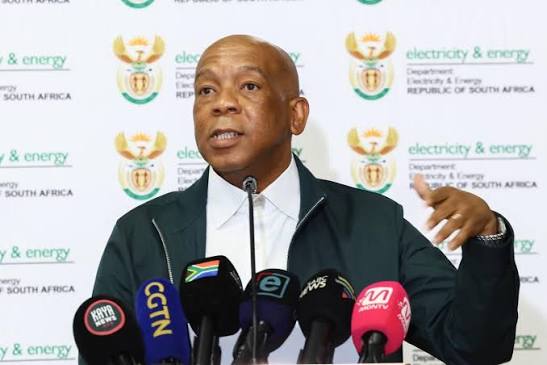
South Africa’s Minister of Electricity and Energy, Hon. Kgosientsho Ramokgopa, has announced broad reforms to the country’s electricity pricing framework aimed at making power bills more transparent, improving affordability and ensuring consumers are not charged for inefficiencies elsewhere in the electricity system.
Speaking at a press briefing on Tuesday, Hon. Ramokgopa said the revised policy would establish a clearer and more cost-reflective tariff structure, allowing consumers to understand exactly how their electricity bills are calculated.
Under the proposed framework, electricity bills would be broken down into separate components, including energy and generation costs, transmission and distribution charges, ancillary services and municipal surcharges.
Hon. Ramokgopa said the approach would enable consumers to see how individual charges contribute to the final amount they are required to pay.
He also raised concerns about the practice of recovering municipal electricity debt and non-payment costs through tariffs paid by consumers who settle their bills on time.
According to him, the existing system effectively places part of the financial burden created by non-paying customers and municipalities on compliant consumers.
The minister estimated that between 1 and 2.5 percentage points of current electricity tariffs could be linked to Eskom’s inability to recover money owed through municipalities.
He said the revised policy would seek to prevent such costs from being transferred to consumers who meet their payment obligations.
The reforms will also introduce stronger measures to protect low-income and vulnerable households through an updated system for administering free basic electricity.
Under the proposed arrangement, electricity beneficiary information would be linked with Home Affairs and social grant databases to help identify households that qualify for the support.
The system would also carry out automatic annual checks to determine whether households remain eligible as their financial circumstances change.
Hon. Ramokgopa said the new approach would reduce the administrative burden currently placed on municipalities, which are required to regularly maintain and update their beneficiary databases.
The announcement comes as the government reports progress in addressing load shedding and load reduction across South Africa.
Hon. Ramokgopa said the country had effectively moved beyond the worst period of load shedding and expressed confidence that the progress could be sustained.
He also announced that load reduction had been eliminated in seven of South Africa’s nine provinces, ahead of the government’s October target.
The Eastern Cape became the seventh province to reach the milestone the previous week, leaving Gauteng and KwaZulu-Natal as the only provinces where load reduction remains an issue.
The government had previously set March 2027 as the deadline for resolving load reduction in the two provinces, although Ramokgopa said the work could be completed earlier.
He cited cooperation from the premiers of Gauteng and KwaZulu-Natal as an important factor in achieving the target.
The minister said further measures would be announced to ensure that load reduction does not return after it has been eliminated.
The revised electricity pricing framework will also make provision for negotiated pricing arrangements for strategically important industries.
Hon. Ramokgopa said such agreements would help protect major industrial users from excessive electricity costs that could threaten their operations and result in job losses.
The government is already engaging major industrial electricity consumers, including smelters, and has publicly disclosed discussions with companies such as Samancor and Glencore.
He said approximately seven other companies were being considered for concessional electricity tariffs.
The new policy is expected to guide the activities of the National Energy Regulator of South Africa (NERSA), Eskom, municipalities and other participants in the country’s increasingly liberalised electricity market.
The framework will therefore apply beyond the traditional Eskom-municipality model to include independent power producers, electricity traders and companies entering into bilateral power supply agreements.
Hon. Ramokgopa said the overall objective was to establish an electricity pricing system that is transparent, efficient and fair, while protecting vulnerable households, preventing compliant consumers from carrying the cost of non-payment and supporting industries that are critical to the economy.