

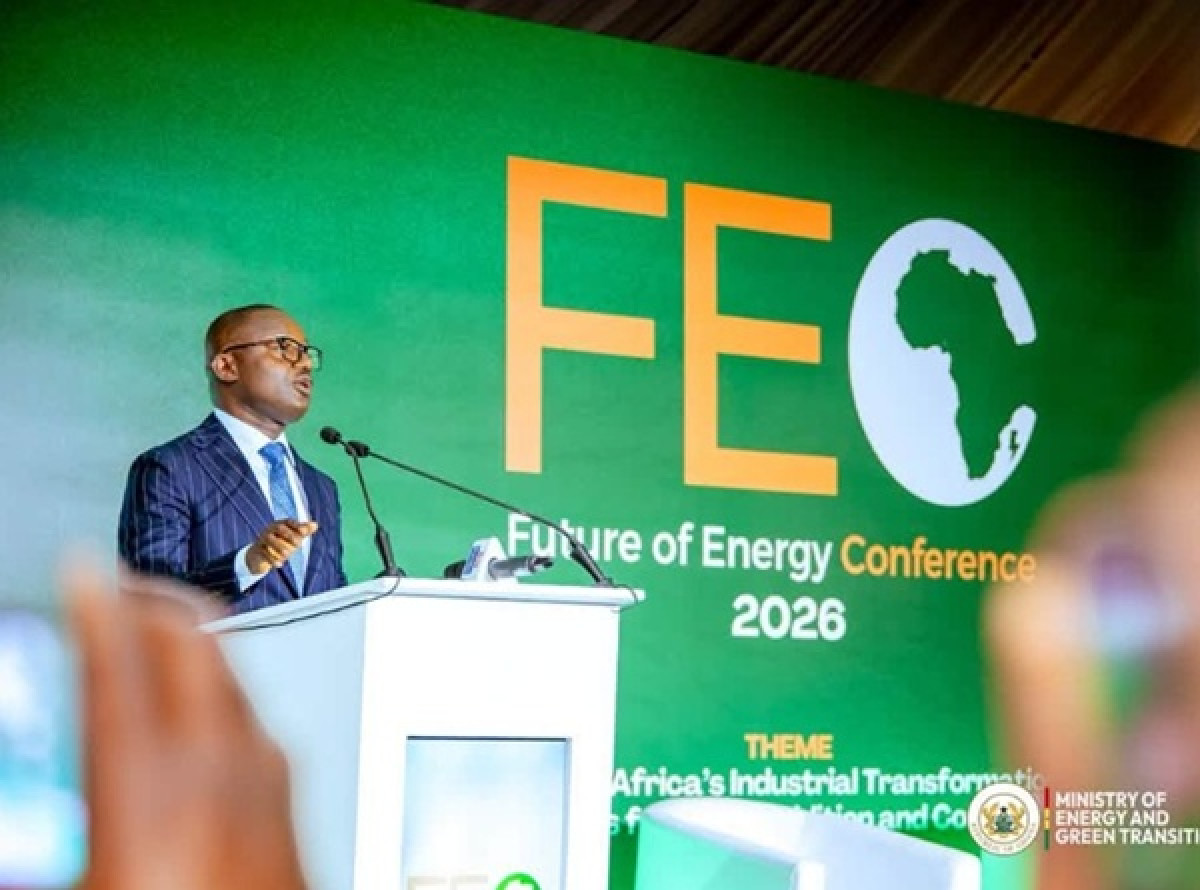
Ghana’s Minister for Energy and Green Transition, Hon. Dr. John Abdulai Jinapor, has stressed the need for Africa to build reliable, affordable and resilient energy systems to support industrialisation, job creation and economic growth.
Speaking at the Future of Energy Conference 2026 in Accra, Hon. Dr. Jinapor said Africa’s industrial transformation would depend on dependable electricity, financially sustainable utilities, resilient power grids, sustainable contracts and policies that enable the continent to convert its natural resources into industries and jobs.
The two-day conference, organised by the Africa Centre for Energy Policy (ACEP), was held under the theme, “Powering Africa’s Industrial Transformation: Energy Systems for Value Addition and Competitiveness.”
Hon. Dr. Jinapor said Africa must move beyond simply expanding electricity access to households and focus on providing sufficient and reliable power for factories, industrial clusters and other productive sectors.
“Our objective must not simply be to finance more energy infrastructure. It must be to build an African energy system capable of powering an industrial, competitive and prosperous continent,” he said.
He noted that reliable, affordable and scalable electricity was essential for manufacturing, mineral processing, local value addition and employment creation.
According to Hon. Dr. Jinapor, achieving this would require stronger cooperation among governments, investors, development finance institutions, utilities, technology providers, academia and civil society.
He said African countries must mobilise the necessary investment, improve policy coordination and develop energy systems capable of supporting industrial growth and reducing the continent’s dependence on raw commodity exports.
Hon. Dr. Jinapor said Ghana’s electricity consumption increased by about 4.7% to 25,836 GWh in 2025, reflecting growing demand for power.
To meet future demand while ensuring affordability, he said the government had introduced the Energy Commission (Planning and Competitive Procurement of Additional Electricity Generation Capacity) Regulations, 2025, L.I. 2508.
The regulations provide a framework for competitively procuring additional generation capacity, with the aim of ensuring that new power projects are based on actual demand, cost and value for money.
“Generation must be procured based on need, cost and value for money, in the interests of the economy, consumers and the long-term sustainability of the sector,” Hon. Dr. Jinapor said.
He also highlighted reforms undertaken in Ghana’s energy sector, including the renegotiation of agreements with independent power producers, which he said had generated savings of about $252 million while maintaining investor confidence and respecting contractual obligations.
Hon. Dr. Jinapor further said the government had cleared approximately $1.47 billion in legacy energy sector debt, strengthened the Cash Waterfall Mechanism and increased declared sector payments from about GH¢6 billion to GH¢15 billion.
He added that the government had also restored the $500 million World Bank Partial Risk Guarantee for the Sankofa Gas Project.
Mr. Benjamin Boakye, Executive Director of ACEP, said Africa’s ability to attract investment into its energy sector would depend largely on the credibility of reforms, regulatory certainty and policy consistency.
He warned that weak regulation and unpredictable market conditions continued to discourage private capital.
“Investment will only come where there is predictability, transparency and a clear path to recovery for capital,” Mr. Boakye said.
He added that energy systems designed to support industrial growth must be supported by fair, credible and sustainable market rules.
Ms. Cloudine Sagam of the Africa Miners Development Centre also highlighted the importance of reliable and competitively priced electricity in promoting mineral beneficiation and local value addition.
She said Africa could not effectively process more of its mineral resources without adequate energy supply for mining and industrial operations.
“The mining sector cannot talk about value addition without talking about energy,” she said.
Ms. Sagam urged governments to better align energy policies with mining, infrastructure and industrial development strategies to maximise the economic benefits of Africa’s mineral resources.
The conference ended with calls for stronger governance, integrated planning and financing frameworks capable of attracting private investment while safeguarding the public interest.
More than 400 participants from the energy, mining, policy and investment sectors attended the event.
The discussions reinforced the view that energy must be treated not merely as a standalone sector, but as a critical foundation for Africa’s industrialisation, economic competitiveness and long-term development.