


The Chamber of Oil Marketing Companies (COMAC) has called for the immediate suspension of a new provision in Ghana’s Customs Act that shifts the point at which downstream petroleum taxes are accounted for, warning that the change could raise fuel prices, slow government revenue collection and expose the country to supply disruptions.
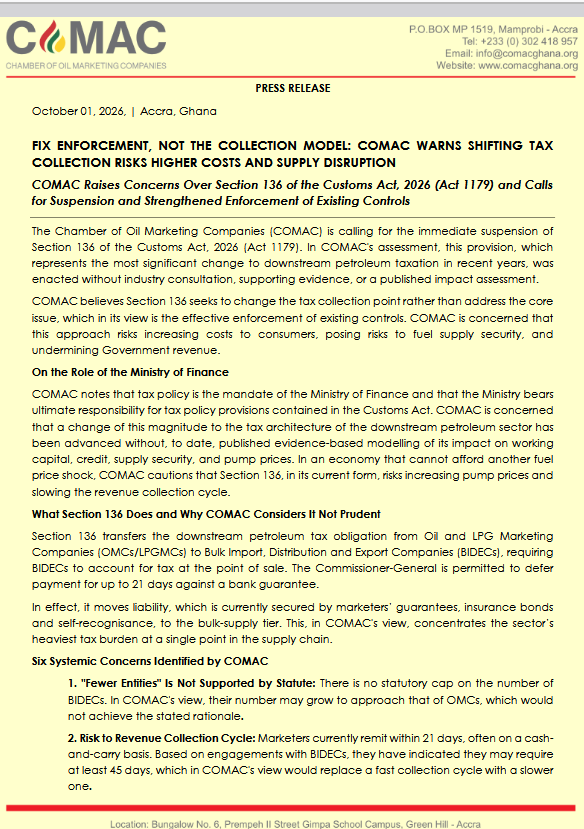
COMAC said Section 136 of the Customs Act, 2026 (Act 1179), transfers the responsibility for accounting for downstream petroleum taxes from Oil and LPG Marketing Companies (OMCs/LPGMCs) to Bulk Import, Distribution and Export Companies (BIDECs), with tax becoming payable at the point of sale.
The Chamber, in a statement signed by its CEO and Industry Coordinator, Dr Riverson Oppong, said the change, which it described as one of the most significant adjustments to the downstream petroleum tax framework in recent years, had been enacted without adequate industry consultation, published impact assessments or evidence-based modelling of its likely effects.
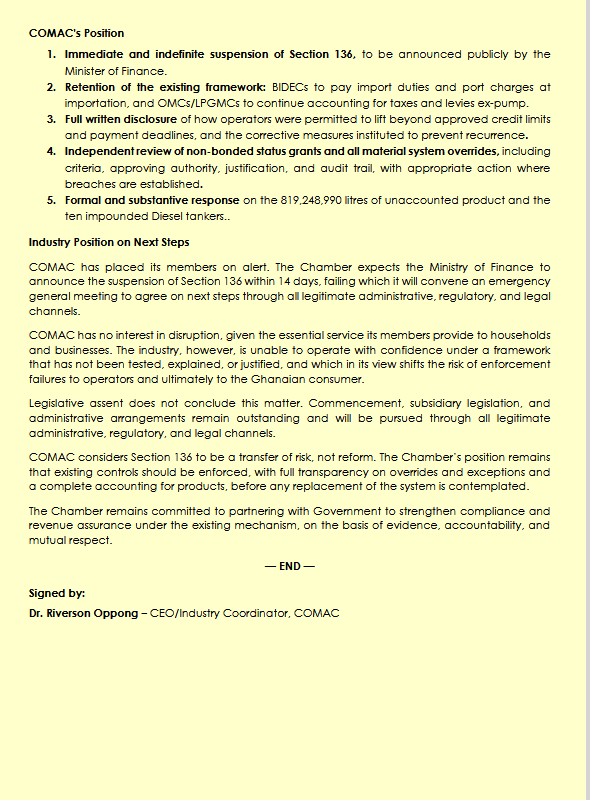
The Chamber is calling on the Minister of Finance to suspend the provision indefinitely and retain the existing arrangement under which BIDECs pay import duties and port charges at importation, while OMCs and LPGMCs account for taxes and levies ex-pump.
Under Section 136, the Commissioner-General of the Ghana Revenue Authority (GRA) may defer payment for up to 21 days against a bank guarantee. COMAC said this would move the tax liability to the bulk-supply end of the chain, potentially concentrating a large portion of the sector’s tax exposure among BIDECs.
The Chamber said the resulting financing requirements could increase costs for bulk suppliers, which could ultimately be passed on to consumers through higher pump prices.
COMAC also questioned the assumption that moving the tax obligation to BIDECs would simplify collection by reducing the number of entities involved.
It said the law does not place a statutory limit on the number of BIDECs, meaning their numbers could eventually increase to levels comparable with OMCs.
The Chamber also raised concerns about the speed of revenue collection. It said marketers currently remit taxes within 21 days and often operate on a cash-and-carry basis, while some BIDECs had indicated during engagements that they could require at least 45 days to settle their obligations.
Such a change, COMAC said, could lengthen the government’s revenue collection cycle rather than improve it.
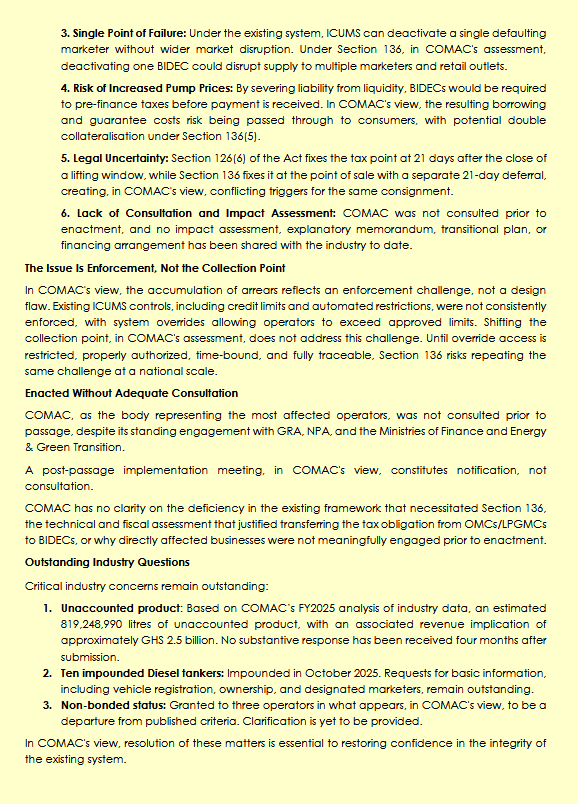
Another concern is the potential impact of a default by a major bulk supplier. Under the current system, COMAC said, the Integrated Customs Management System (ICUMS) can deactivate an individual marketer that defaults without necessarily affecting the wider market.
Under the proposed arrangement, the Chamber argued, action against a BIDEC could affect several marketers and retail outlets supplied by that company, creating what it described as a potential “single point of failure” in the supply chain.
COMAC further questioned the interaction between Section 136 and another provision of the Customs Act concerning the timing of tax obligations.
It said Section 126(6) establishes a tax point 21 days after the close of a lifting window, while Section 136 establishes taxation at the point of sale with a separate 21-day deferral. The Chamber said the two provisions could create uncertainty over when the same consignment becomes subject to payment.
Enforcement concerns
COMAC said the accumulation of tax arrears in the sector should be addressed through stronger enforcement of existing controls rather than by changing the collection point.
It cited existing ICUMS mechanisms, including credit limits and automated restrictions, but alleged that system overrides had allowed some operators to exceed approved limits.
The Chamber is demanding written disclosure of how such operators were permitted to lift products beyond approved credit limits and payment deadlines, as well as details of measures introduced to prevent a recurrence.
It is also seeking an independent review of non-bonded status granted to three operators and of material system overrides, including the criteria applied, approving authorities, justifications and audit trails.
COMAC said these matters needed to be resolved before a new collection framework was imposed.
The Chamber also raised questions over what it described as unaccounted-for petroleum products. Based on its analysis of industry data for 2025, COMAC said an estimated 819,248,99 litres of product were unaccounted for, with an associated revenue implication of about GH¢2.5 billion.
The Chamber said it had submitted the issue to the relevant authorities but had not received a substantive response four months later.
It also cited 10 diesel tankers impounded in October 2025, saying requests for information on their registration, ownership and designated marketers remained outstanding.
COMAC said clarification was also pending on the granting of non-bonded status to three operators, which it said appeared to depart from published criteria.
14-day deadline
The Chamber has given the Ministry of Finance 14 days to publicly announce the suspension of Section 136.
If that does not happen, COMAC said it would convene an emergency general meeting to determine its next steps through what it described as legitimate administrative, regulatory and legal channels.
COMAC said it did not seek disruption to the downstream petroleum market, acknowledging the essential role its members play in supplying households and businesses.
However, it said operators could not be expected to work with confidence under a framework that, in its view, had not been adequately tested, explained or justified.
The Chamber said it remained willing to work with the government to strengthen compliance and revenue assurance, but wanted the existing mechanism enforced, system overrides and exceptions fully disclosed, and outstanding product-accounting issues addressed before any replacement of the current collection system was considered.
The Ministry of Finance had not, in the statement, provided a response to COMAC’s concerns.
Source: Energy Ghana