
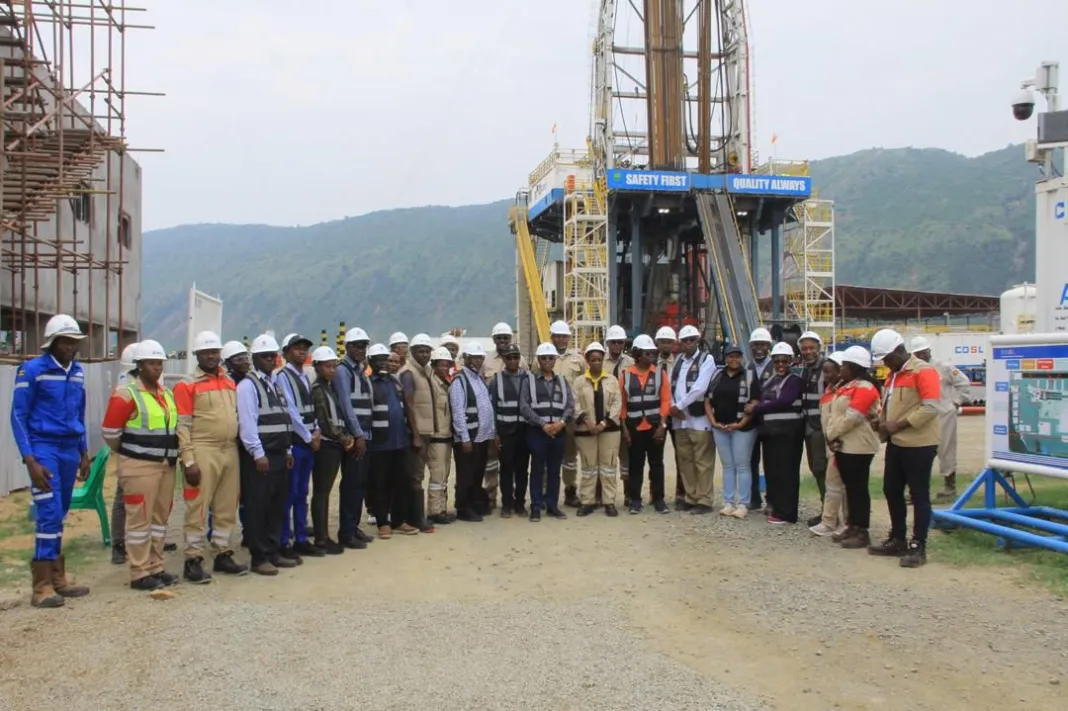

Uganda’s ambitious $4 billion oil refinery project in Kabaale, Hoima District, is advancing steadily and is expected to begin operations between late 2029 and early 2030. The 60,000-barrel-per-day refinery, jointly developed by the Uganda National Oil Company (UNOC) and UAE-based Alpha MBM Investments, marks a major milestone in Africa’s efforts to boost local refining capacity and reduce reliance on imported fuels.
The partnership, established under a 2025 agreement, grants UNOC a 40% equity share, while Alpha MBM holds 60%. The facility will anchor Uganda’s transition from crude oil exporter to refined-product hub, contributing significantly to Africa’s downstream energy expansion alongside Ghana’s Sentuo Refinery and Nigeria’s Dangote Petroleum Refinery.
Speaking at the 2025 African Energy Week in Cape Town, Michael Nkambo Mugerwa, General Manager of the Uganda Refinery Holding Company, said the refinery will process more than fuel — including petrochemicals, fertilizers, kerosene, and gas products — to capture the full value chain. He emphasized that the project aligns with Africa’s broader vision of energy independence and industrialization.
The refinery is part of the Hoima Industrial Park, a $3–4 billion initiative designed to attract further investments worth up to $2 billion. It is supported by major infrastructure upgrades such as roads, water systems, and a 200 MW high-voltage power supply, laying the groundwork for industrial growth in Uganda’s western region.
To finance the project, the Ugandan government opted for a full equity model after challenges with international debt financing, as global banks increasingly avoid fossil fuel projects. Despite this, 15 investors have already pledged participation, reflecting strong regional confidence in Uganda’s energy agenda.
Once completed, the refinery will supply not only Uganda’s domestic market but also neighboring Tanzania and the Democratic Republic of Congo, strengthening regional energy trade and economic integration.
Uganda’s Permanent Secretary for Energy, Irene Bateebe, highlighted that the refinery complements the government’s broader plan to expand national power capacity to 10,000 MW, integrating hydro, solar, and nuclear energy. This strategy, she said, aims to build a diversified and sustainable energy future.
The project follows in the footsteps of Nigeria’s successful $20 billion Dangote Refinery, which has already reshaped fuel supply dynamics across West Africa. Industry observers note that Uganda’s model mirrors this approach — nationally strategic yet regionally beneficial.
As global energy priorities evolve, Uganda’s refinery stands as a symbol of Africa’s drive toward self-sufficiency, value addition, and economic sovereignty. For Uganda, it is more than an energy project — it is a declaration of independence in the continent’s quest for sustainable growth and industrial resilience.