
Ghana has generated $2.7 billion in gold export earnings between January and April 2025, President John Dramani Mahama has announced. The revenue was realised through exports overseen by the Precious Minerals Marketing Company (PMMC) and Goldbod, the country’s newly established national trading platform.
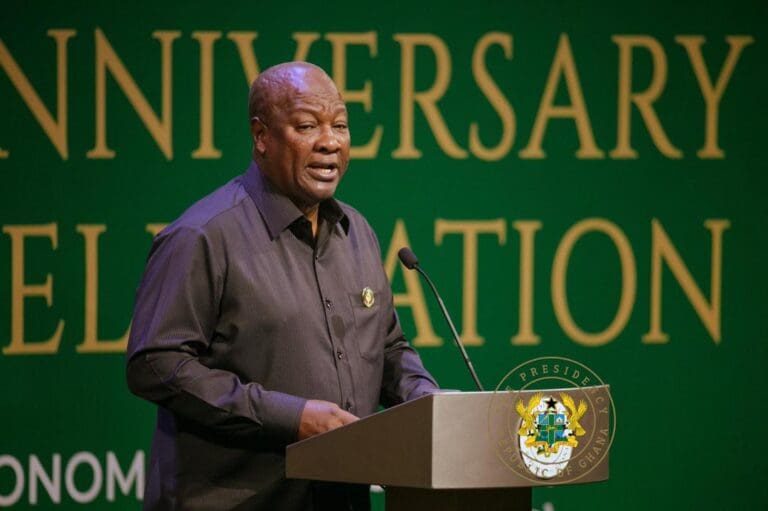
Speaking at the Global Mining Summit in Accra on Monday, June 2, President Mahama described the Goldbod initiative as a cornerstone of his government’s ongoing reforms in the gold mining sector. The initiative, he said, is already yielding strong results by enhancing transparency, curbing illegal practices, and increasing national revenue.
“The Goldbod, a key plank in my administration’s strategy to reform the gold mining sector and ensure maximum benefit for Ghanaians from our gold resources, has taken off,” President Mahama told the summit. “In its short existence, it has sanitised the gold sector, ensuring maximum returns from our gold export.”
According to the President, the $2.7 billion revenue is only the beginning, with projections indicating even greater earnings by year-end. “This figure is expected to increase exponentially throughout the year,” he added.
The Goldbod platform was launched as part of broader efforts to formalise Ghana’s gold trade, reduce the influence of illegal mining operations, and streamline transactions through official channels. It works in tandem with the PMMC to ensure gold purchases, exports, and payments are transparent and traceable.
President Mahama emphasised that the reforms are helping to build a more accountable and sustainable mining sector. “The results so far show that these reforms are delivering real benefits and creating a more transparent and accountable gold trading system for the country.”
Despite being Africa’s top gold producer and home to vast reserves of lithium, bauxite, iron ore, and manganese, Ghana has struggled for decades to convert its mineral endowment into broad-based industrial and economic transformation. Speaking at the summit, President Mahama attributed this disconnect to historical patterns of foreign control over extractive operations, weak domestic linkages, and underinvestment in value addition.
The president announced a new policy direction to use mining as a springboard for Ghana’s industrialisation. Under the revised approach, the government will align mining with other strategic sectors, including manufacturing, energy, logistics, and technical education, to foster integrated industrial growth. Support from Ghanaian research institutions and technical universities is expected to strengthen innovation and skills development across the mining and processing ecosystem.
Additionally, the government plans to expand local participation by facilitating Ghanaian ownership along the entire mining value chain. This will be achieved through public listings, investment vehicles, and incentives designed to crowd in domestic capital and entrepreneurship.
On clean energy minerals, particularly lithium, which is crucial for electric vehicle batteries and renewable energy storage, President Mahama unveiled Ghana’s ambition to become West Africa’s clean energy hub. He said the government would issue clear and investor-friendly regulations to guide exploration, processing, and trade in critical minerals. Emphasis will also be placed on technology transfer, environmental stewardship, and Ghanaian equity in emerging clean energy industries.
“Our goal is to become a regional centre for battery production and green technologies,” Mahama said, citing Ghana’s strategic advantage as the host of the African Continental Free Trade Area (AfCFTA) Secretariat.
The summit brought together key players from the mining industry, regulatory bodies, and international stakeholders, all focused on advancing responsible resource extraction and revenue optimisation across Africa’s mining landscape..