

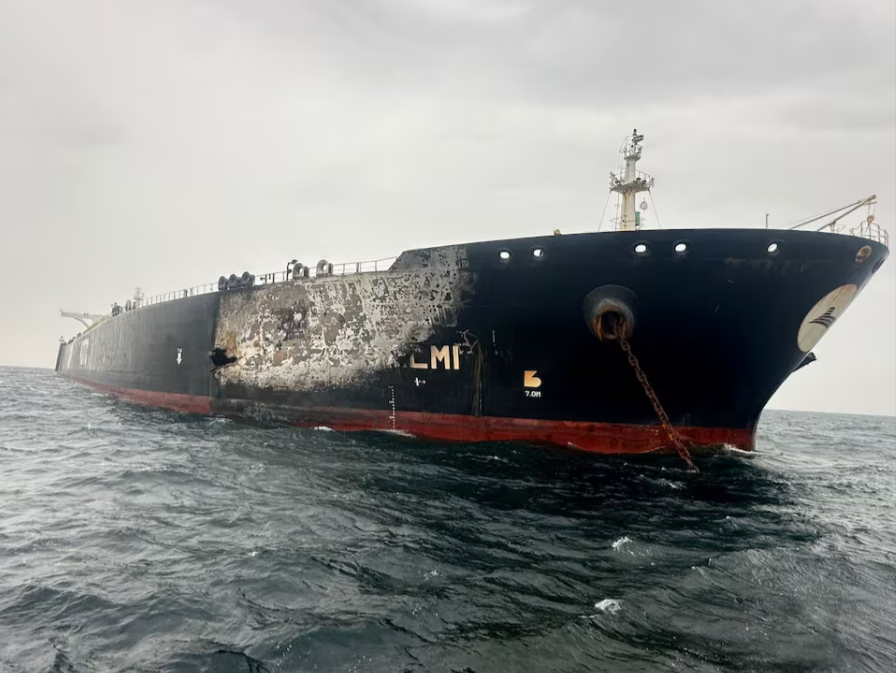
Iran launched a drone strike on a large oil tanker near Dubai on Tuesday, escalating tensions in the Middle East despite warnings from Donald Trump that the United States would target Iran’s energy infrastructure if Tehran refused a peace deal and kept the Strait of Hormuz closed.
The Kuwait-flagged tanker Al-Salmi, carrying about two million barrels of crude oil from Saudi Arabia and Kuwait to China, caught fire after the attack.
Authorities in Dubai said the blaze was brought under control and no crew members were injured, although the vessel’s hull was damaged.
The tanker is owned by Kuwait Petroleum Corporation, which confirmed the damage but said no oil spill occurred.
Iran’s Islamic Revolutionary Guard Corps said the intended target was a nearby container vessel it linked to Israel, the Singapore-flagged Haiphong Express, which had been anchored close to the tanker at the time of the strike. Shipping data suggests the oil tanker may have been hit inadvertently.
The attack marks the latest escalation in the month-long conflict that began after U.S. and Israeli strikes on Iran in late February, a confrontation that has disrupted global energy supplies and raised fears of wider regional instability.
Oil prices briefly surged following the incident, with benchmark Brent Crude rising sharply amid concerns over shipping through the Strait of Hormuz, a key route that normally carries roughly one-fifth of the world’s oil and liquefied natural gas supplies.
Diplomatic efforts to calm the crisis are ongoing. Ishaq Dar is visiting China for talks after hosting discussions with Turkey, Egypt and Saudi Arabia, while China has urged all sides to halt military operations and ensure safe navigation in the strait.
Washington has warned Tehran that failure to reach a peace agreement could lead to strikes on critical Iranian energy facilities, including the export hub on Kharg Island.
Meanwhile, the conflict continues to widen, with Iran-aligned Houthis in Yemen launching attacks toward Israel and renewed fighting between Israel and the Iran-backed group Hezbollah in southern Lebanon.
The United States has also begun reinforcing its military presence in the region, deploying thousands of troops from the 82nd Airborne Division as the White House pushes for a deal before an April 6 deadline to reopen the Strait of Hormuz.
The ongoing hostilities have pushed global oil prices sharply higher and raised fears of prolonged disruptions to energy markets, with gasoline prices in the United States climbing above $4 per gallon for the first time in more than three years.