
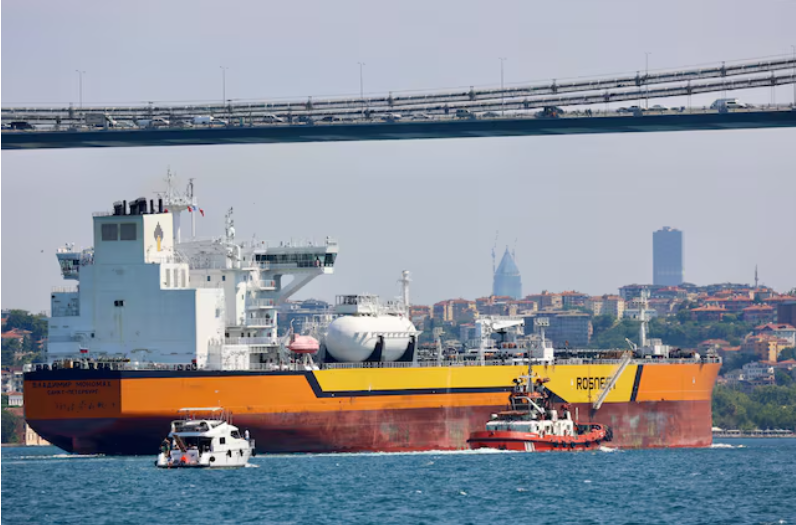

The European Union is seeking coordination with its Group of Seven partners before advancing a proposed full ban on maritime services supporting Russia’s seaborne crude oil exports, its sanctions envoy said on Thursday.
Speaking at a news conference in Bishkek, EU sanctions envoy David O’Sullivan said the bloc favours the sweeping measure but wants agreement among G7 allies in the coming days and weeks before moving forward.
The proposal, tabled by the European Commission on Feb. 6, would prohibit any services that facilitate Russia’s seaborne crude exports, significantly expanding beyond earlier, more targeted sanctions.
O’Sullivan noted that the EU is currently enforcing the oil price cap, recently lowered to $44 per barrel, and said Russian oil and gas revenues have declined sharply in recent months as a result.
Diplomats say Brussels is particularly attentive to the stance of the United States, whose backing is viewed as critical to the effectiveness of any coordinated maritime ban.
Russia ships more than a third of its oil via Western tankers, many linked to operators in Greece, Cyprus and Malta, with exports largely destined for India and China under existing price-cap arrangements.
A full maritime services ban would effectively end that practice and could render the current price cap mechanism obsolete, raising questions over enforcement and market impact.
The Commission has yet to outline how the ban would be phased in or whether it would later extend to refined products or other energy exports such as liquefied natural gas.
The G7 first introduced the price cap in 2022, and last year the EU and partners including Britain and Japan lowered it to reflect market conditions; it now stands at $44.10 per barrel.
While Washington did not formally join the price-cap coalition, it has imposed full asset freezes on Russia’s top oil producers, Rosneft and Lukoil, measures that the EU has so far not mirrored.